


Last Thursday I published another long-form piece on the Animalz blog. The one from the week before — about context engineering — was ~65% AI-generated. This latest one, not at all.
Don’t Stop at Workflows: Build a Compounding Content System went through four versions, two human editors, and months of iteration before it was ready. I had to think (= write) my way through what I really wanted to say.
With the context engineering article, the purpose was clear from the start: define the concept based on my own experience in the AI trenches.
The content system piece was much harder.
I started by breaking down the entire architecture of our LinkedIn content program. Too complex. The second version was a mix of principles and architecture, which was even more confusing. Then I landed on a “here’s how we built it” story which felt right. But even that approach needed a major rewrite before it finally worked.
Through all of this, I did use AI for sparring and polishing. And after each round it said: this is great, ship it.
My human editors disagreed.
AI still has some way to go before it can really diagnose whether something works. Not just at the sentence level, but strategically, structurally, conceptually.
And yet the article in its current form couldn’t have existed without AI either.
Claude Code handled the entire publishing workflow to the Animalz CMS (this might sound trivial if you’ve never had to publish a blog post, but anyone who has knows this ordeal can take 15–45 minutes). The Whimsical MCP generated the flowcharts. Nano Banana Pro (Gemini’s image model) created all the visuals. And the assets discussed in the article — like the intelligent onboarding form and Animalz Chrome plugin — I vibe-coded.
The article would never have existed in its current form without AI. But it also proves that serious thinking and strategy still need human expertise, experience, and judgment.
Current AI status: can’t live with it, can’t live without it.
Read Don’t Stop at Workflows: Build a Compounding Content System on the Animalz blog.
Reads & Listens
Here’s what stood out in my reading and listening this week.
A Visualization of the Shifting AI Bubble Narrative
Since October, I’ve been highlighting articles about whether we’re in an AI bubble. Back then, most prominent voices were hedging or calling it outright: Siegler called it “a bet that could bust,” Thompson said bubbles build infrastructure, Marks drew dotcom parallels, Newport said agents failed to deliver.
Then the models started catching up. Shumer declared the “hitting a wall” debate over. And this month, Ben Thompson explicitly flipped: “I no longer believe we’re in a bubble.” (Not everyone agrees: Kedrosky still called it a bubble “without question.”)
I used Claude Code to visualize the current trend based on these articles:
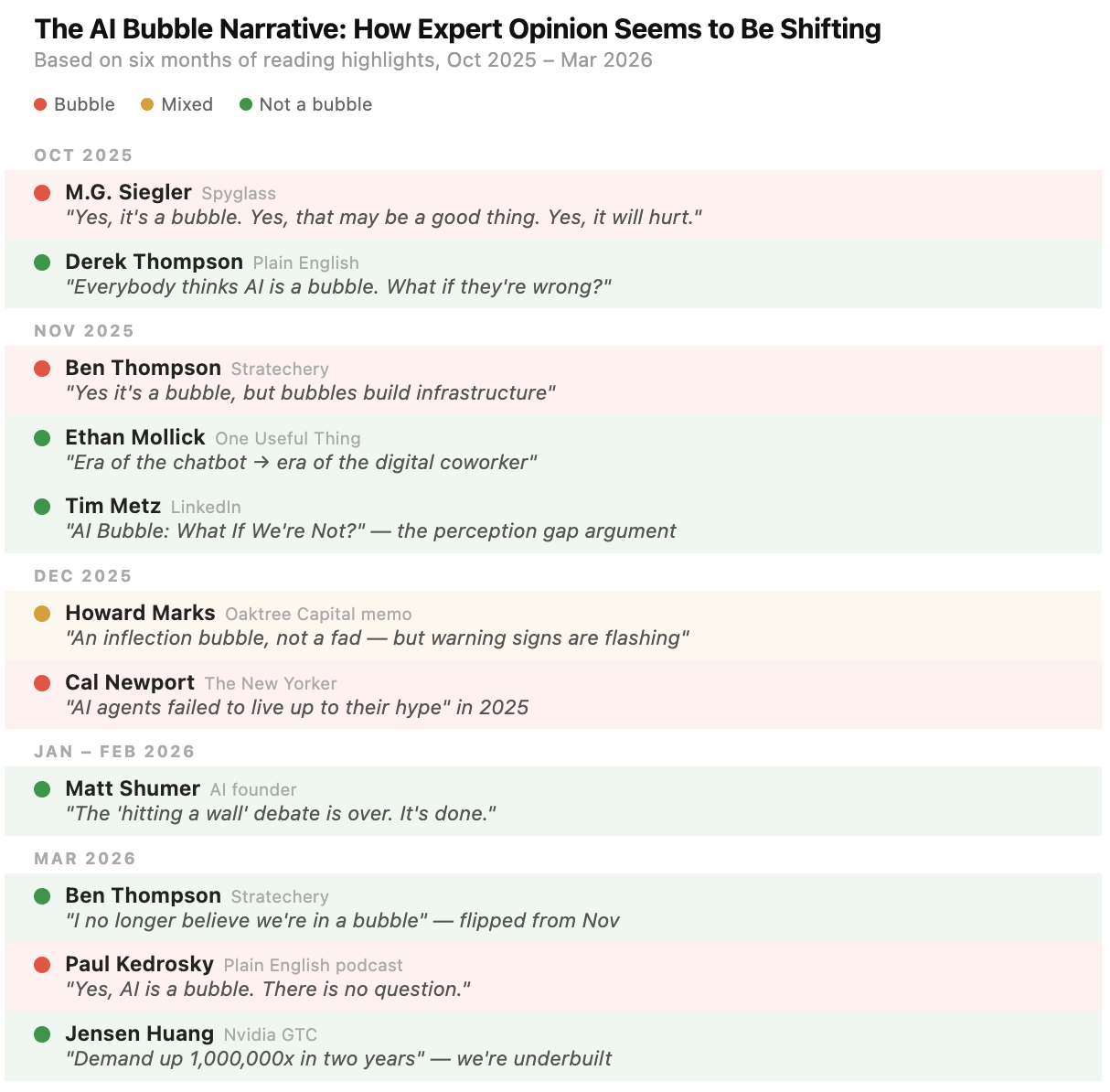
Also interesting is that Claude Opus 4.5 shipped in November, and Opus 4.6 in February. The timing of those releases lines up pretty well with the shifts we see in the visual. Not a coincidence I think.
54% of NYT Readers Preferred AI Writing in a Blind Test
The New York Times ran a blind taste test: human writing vs. AI writing, five questions, pick your favorite. 86,000 people took it. 54% preferred the AI version. Preference was even higher for factual reporting (62%) than opinion pieces (48%).
Back in December, the FT’s Elaine Moore already argued that AI detection depends more on context than content. If you know someone’s style is sparse and they produce 800 words of florid text: sure, maybe AI. But in a blind test? Good luck.
Got Claude Code Questions?
I’m working on an extended Claude Code guide for the Animalz blog. If you have specific questions about Claude Code, things you’d like covered, or topics you’re curious about: hit reply or drop a comment below. I’m actively collecting input for the guide.
Thanks for reading!
Tim