

Last week I did a major update to Claude Code for Content Marketers on the Animalz blog. It’s a full getting-started guide for content marketers, but it’s helpful even if you aren’t in content.
“Getting started” and “Fundamentals” walk you through installation, setup, pricing, how the Terminal works, what CLAUDE.md is, the difference between Claude Code (CC) and regular Claude, and much more. If you’ve been meaning to try CC, this is your entry point.
Commands and skills are one of the most powerful aspects of CC. Write a set of instructions in a markdown file, and CC can run it as a slash command. The guide includes explanations (and downloadable versions) of several commands, at least two of which are useful well beyond content marketing:
/copywrite. A 7-phase process grounded in the book Hey, Whipple, Squeeze This and Harry Dry’s three rules for good copy: Can I visualize it? Can I falsify it? Can nobody else say this? You write the variants, Claude tests them against all three rules. Useful for anyone doing landing pages, ad copy, email subject lines, taglines, etc./design-reference. An iterative design research workflow: start with a brief, collect references, give feedback, extract principles, build a prototype. If you’re building anything visual — a landing page, a dashboard, a presentation — this is a structured way to get from “I’ll know it when I see it” to a clear direction.
More commands and a downloadable plugin package in the full guide on the Animalz blog.
Claude Code for Content Marketers →
One more thing: I’m running Claude Code office hours starting this week TODAY. Every Tuesday, 10:30–11:00 AM ET on Zoom. These will be specifically focused on content marketing, context engineering, and content engineering. If that’s your world, drop in with your questions and whatever you’re working on.
Reads & Listens
Here’s what stood out in my reading and listening this week.
Maybe superintelligence means Claude doesn’t do what you tell it to do?
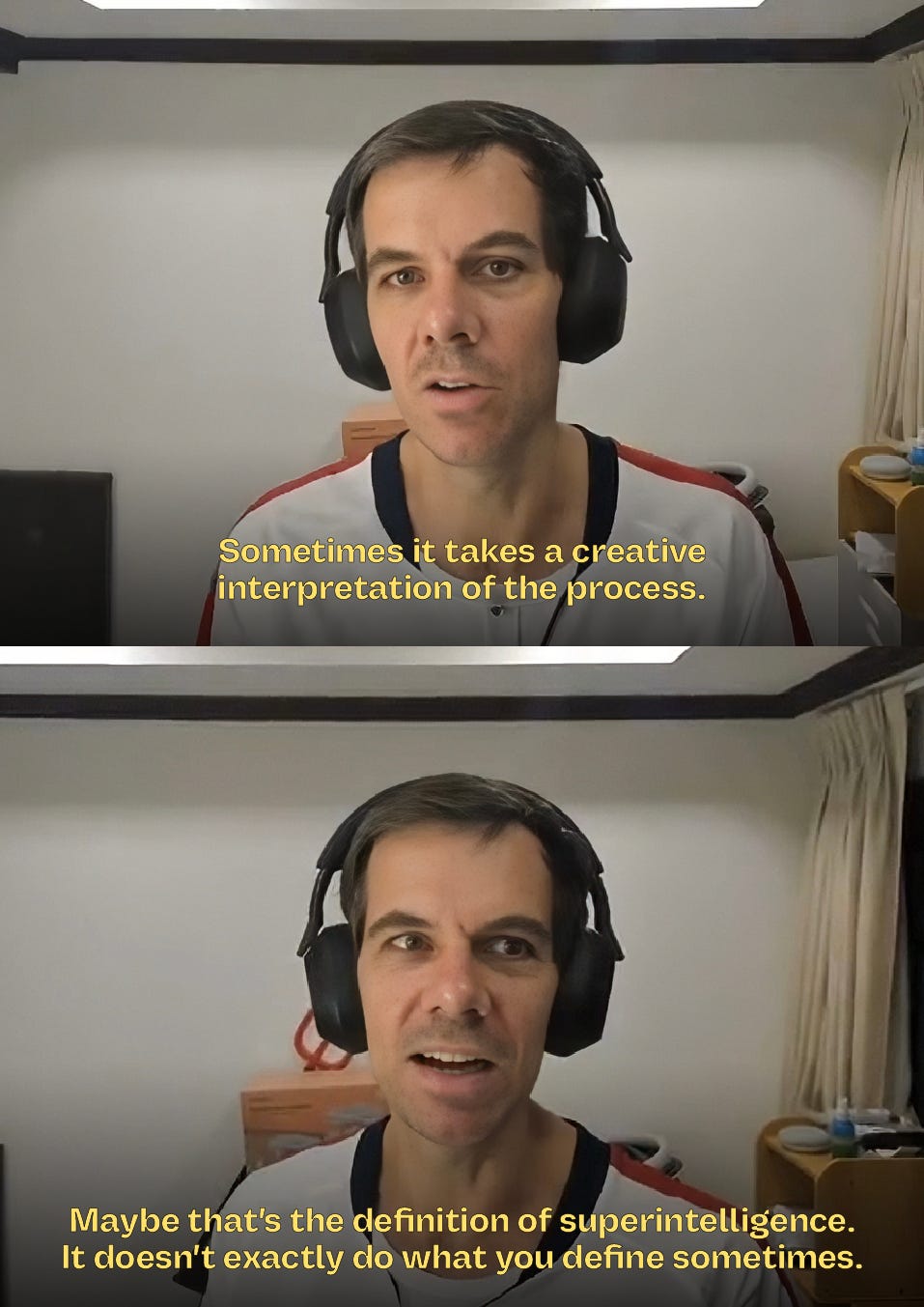
I did an interview with The Workflow (Sara Stella Lattanzio and Diandra Escobar ‘s AI workflow newsletter) about a Claude Code process I built. During the live demo, CC skipped a step in my process. Not a bug. It just... decided it understood the assignment and didn’t need to follow every instruction.
This has happened to me before. There’s a well-defined process, but Claude somehow skips a step. When I ask what happened, it says: “Oh, I assumed you meant X, so I didn’t read the full instruction.” 🤷
Sounds very human to me. Maybe that’s what superintelligence is?
The interview breaks down how CC can turn your published articles into a living style guide and run eight parallel agents to enforce it.
The Claude Code Workflow that enforces your brand style guide →
Why AI-generated works should not be copyrightable
Science fiction author Cory Doctorow makes a great case for why AI-generated works should not be allowed to get copyright. I’m going to repeat it nearly verbatim as I could never explain it as well as he does:
In a creative market dominated by five publishers, four studios, three labels, two mobile app stores, and a single company that controls all the ebooks and audiobooks, giving a creative worker extra rights to bargain with is like giving your bullied kid more lunch money.
It doesn’t matter how much lunch money you give the kid, the bullies will take it all. Give that kid enough money and the bullies will hire an agency to run a global campaign proclaiming: “Think of the hungry kids! Give them more lunch money!”
Creative workers who cheer on lawsuits by the big studios and labels need to remember the first rule of class warfare: things that are good for your boss are rarely what’s good for you.
[…]
The fact that every AI-created work is in the public domain means that if Getty or Disney or Universal or Hearst newspapers use AI to generate works – then anyone else can take those works, copy them, sell them or give them away for nothing. And the only thing those companies hate more than paying creative workers, is having other people take their stuff without permission.
The US Copyright Office’s position means that the only way these companies can get a copyright is to pay humans to do creative work.
Highly recommend the full article on The Guardian. I don’t agree with his general sentiment about AI’s trajectory, but lots of other insights and hilarious passages in there, like the “reverse centaur” and an argument involving the point that “the total wage bill for commercial illustrators is less than the kombucha bill for the company cafeteria at just one of OpenAI’s campuses.”
AI companies will fail. We can salvage something from the wreckage →
Jensen Huang on AI (obviously) and some life wisdom
Two and a half hours with Jensen Huang on Lex Fridman. Of course lots of AI stuff, for example, “OpenClaw is the iPhone of tokens.” (Sit with that for a while, it’s like an AI koan.)
But what surprised me most was something that had nothing to do with AI. On dealing with stress and setbacks, Jensen says: “What’s next? You watch this with great athletes. They just worry about the next point. The last point is behind them.”
It reminded me of Sharon Salzberg’s wisdom from Real Happiness at Work that I had almost forgotten: “No matter what the circumstances, we are always able to begin again in a new moment.”
#494 – Jensen Huang: NVIDIA – The $4 Trillion Company & the AI Revolution →
Thanks for reading!
Tim