

I keep telling myself the same thing with AI: this’ll take 10 minutes. Two hours later I’m still at it, dozens of prompts into a loop I can’t seem to escape.
My friend Giancarlo and I were trading versions of this on the phone yesterday. We’re both deep into vibe coding, and we’ve both blown many afternoons, evenings, and nights on this mechanic.
There’s always just one more prompt that’s about to fix your problem. The solution, like a fata morgana, just visible on the horizon.
A ritual that gets you out of AI rabbit holes
The decision you face with every interaction: is this a real 10-minute fix, or a 10-hour sinkhole? The problem is both look identical at minute zero.
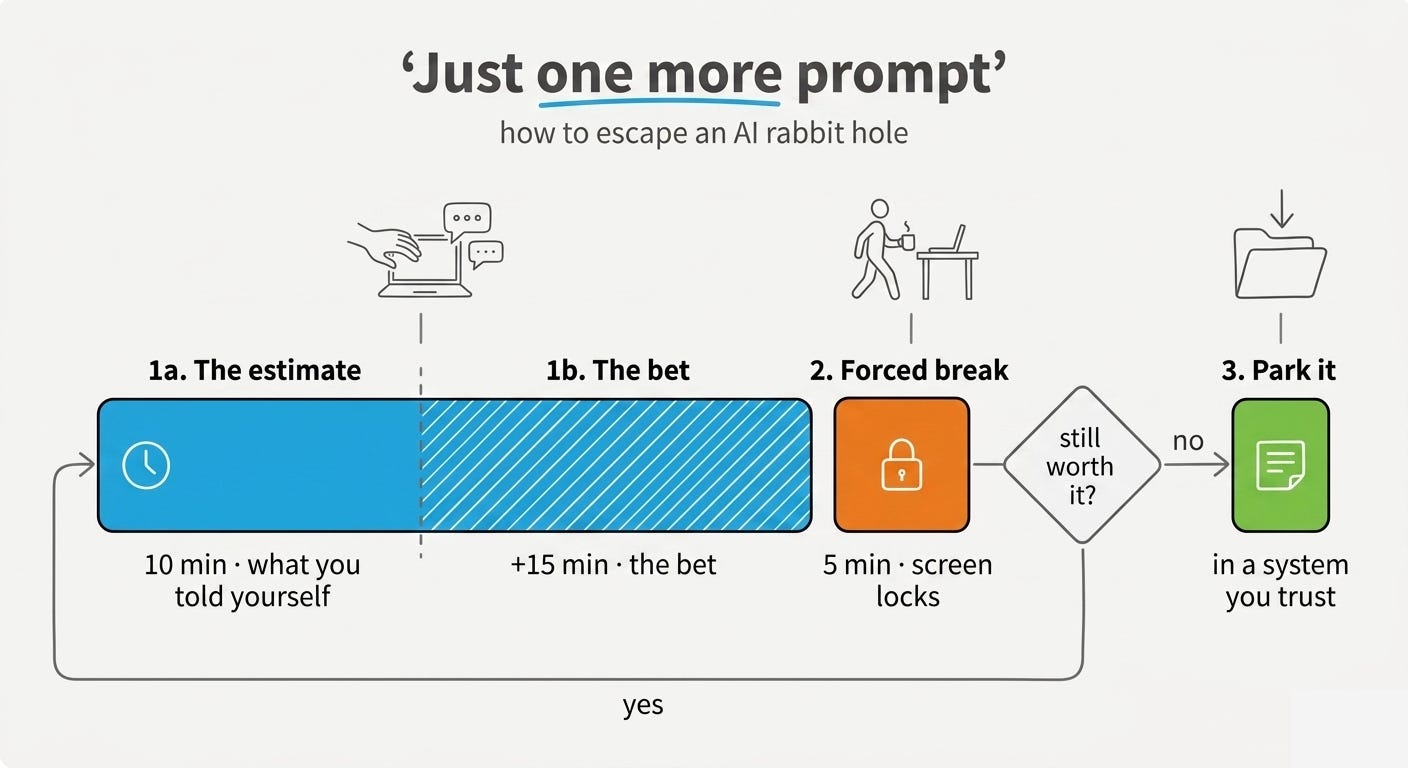
This ritual helps me derisk this decision:
Set a hard timer before you start. 10, 25, 50 minutes.
Take a forced break when it ends. Step away, no exceptions.
Have a handoff system you trust, so stopping isn’t difficult or scary.
That’s the rhythm I’ve landed on after many days (and much sleep) getting wrecked by “one more prompt.” It lets me take real bets on small AI wins with 15 minutes of “sunk cost” risk instead of hours.
1. Set a timer
I set a timer before I start, with a hard cut-off time. Usually 25 minutes (one Pomodoro), which gives me 2.5x the original 10 minute “budget.” If the fix really takes 10, great. If it stretches to 25, that’s still a fine bet on something potentially worthwhile.
The non-negotiable part is what happens once the 25 minutes are up: I’m forced into a five minute break.
2. Take a forced break
I use a Pomodoro app called Lifeline (which I created), and one of its newest features is a session lock I’ve added for this purpose.
Before you start a session, you set your intent (25 minutes, 50, whatever) and tap a small lock icon. When the timer finishes, you get a one-minute grace period, and then your screen locks. You have to take the break.
In the moment, the lock is annoying. You’re “almost there.” You can feel the answer two prompts away. But then you step away from the screen for five minutes, and clarity returns. Usually one of three things becomes obvious:
You’re making progress and want to keep going.
You’re making progress, but this is not where your time should go today.
You’ve been chasing a ghost. Time to drop it.
Most of the time it’s option two or three. Without the forced break, you stay stuck in option one. The hard break pulls you out long enough to see the situation clearly.
3. Have a hand off system you trust
The break only works if you trust you can stop without losing your work. If your brain thinks “I’ll never come back to this,” you’ll keep going regardless of the timer.
This is classic Getting Things Done: you need an external system you trust to free your brain from holding the loop open. The reason AI rabbit holes get sticky is not only that you always feel the end is within reach, it’s also that stopping feels dangerous.
So the final piece of the loop is a fast handoff. Whatever your system is (Notion tasks, Asana, a markdown folder on your drive), have a one-step way to dump the context: what you were doing, where you got to, what’s next.
For me, that’s a Claude Code skill that saves the session and creates or updates a Notion task in about 30 seconds.
With a real handoff, you can park the work and trust you’ll resurface it at the right moment.
🛠️ Claude Code Office Hours
Next session: Tuesday, May 5 at 10:30 AM ET.
What came up last week:
Dane: how do you tell what Claude Code can actually do when it’ll cheerfully agree to anything? We talked about plan mode, scratchpads, and sub-agents reviewing your work with fresh eyes.
Navya: her custom skills started drifting after working through 10-20 blog posts. Claude’s memory was turning per-article feedback into general rules. Audit what gets saved.
Patrick: reframed the cost question. Stop optimizing for one perfect run. Loops are three dollars. Your time is worth more, so don’t hesitate to spin off multiple runs.
Drop in if any of that sounds like your stuck place too.
Reads & Listens
Here’s what stood out in my reading and listening this week.
Getting good results from AI is knowing what to ask for
Ethan Mollick distills managing AI agents to a list of questions you should answer for any task you assign them:
What are we accomplishing, and why?
What are the limits of authority?
What does “done” look like?
What specific outputs do I need?
What interim outputs do I need to follow your progress?
And what should you check before telling me you’re finished?
It’s essentially management 101, but it works for agents, too.
Reasons to keep voting with my feet
Last week I said I’d try GPT-5.5. Then I listened to Ezra Klein interview Alex Bores, the New York state assemblyman who passed the strongest AI safety bill in the USA, and dragged my feet.
Sam Altman publicly says “the democratic process should remain more powerful than companies.” Meanwhile, his OpenAI cofounder Greg Brockman is funding a super PAC whose explicit goal is to crush state legislators (like Bores) who try to regulate AI.
The interview brought back everything that troubled me about AI since reading Karen Hao’s Empire of AI six months ago: Kenya workers paid one to four dollars an hour sorting grotesque content. The terrible politics inside OpenAI. The disregard of security precautions. And Paul Graham’s line about Sam Altman: “Sam is extremely good at becoming powerful.”
The Bores interview pulled it back into focus, so I’m thinking harder about which AI companies I want to feed, and have delayed giving GPT-5.5 a try.
Why Are Palantir and OpenAI Scared of Alex Bores? →
Howard Schultz, in his own words (outside interest)
The Acquired guys interviewed Howard Schultz, founder and former CEO of Starbucks. I’d read his book Onward over a decade ago, and it instantly made me appreciate Starbucks more — that’s how good a storyteller Schultz is.
He does it again in this interview. He recalls how Bill Gates Sr. quietly saved the company from an early death. How he miraculously got a prime piece of real-estate in Milan even local officials thought was impossible. How Steve Jobs advised him to fire his entire leadership team on the spot (which he didn’t). How his father-in-law pulled him aside on a walk and called the business a hobby and told him to get a real job. And on and on and on.
Even when you know how the company turned out, his version has the shape of a movie. The Acquired hosts are always great storytellers themselves, and the three of them together have a rhythm that sails you through the ~3 hour interview.
Starbucks with Howard Schultz →
Thanks for reading!
Tim
I work for myself from home as a travel agent, which often involves a lot of online research and I can often go out of bounds with my time. Of late it has been a problem. I just wanted to thank you for this handy article and the tips and tools to streamline my workflow are really helpful. I always like to stand up at least once an hour for example. and listen to the radio station, which give me the news bulletins, and hence the time. there are some days that I can work completely through the night on projects and thats not helping me be more efficient. Well be applying all these tips suggested and I love that workflow diagram to visualize the plan :)
"The Bores interview pulled it back into focus, so I’m thinking harder about which AI companies I want to feed, and have delayed giving GPT-5.5 a try."
Thanks for this, Tim, and for the Paul Graham quote. It's a thoughtful approach to managing your time and your trust.