

I hear the same things over and over from heavy AI users: “I have a gazillion sessions running in parallel.” “I’m staying up too late too often.” “I’m getting more done, but my todo list keeps getting longer.”
My experience is the same, even though I know what’s going on:1
Multitasking doesn’t work, but AI encourages it.2 Fewer than 3% of people are genuine supertaskers who can do it well. The rest of us think we can, and feel productive doing it, but it’s a mirage.3
The slot machine effect. When a reward shows up every now and then, you keep pulling the lever. AI has exactly this quality: you always feel one prompt away from the solution, or one prompt away from another nice feature. That’s how “just one more prompt” keeps you going until 3 a.m.
Jevons’s paradox. I wrote about this before. The idea: make a resource cheaper to use, and, instead of banking the savings, people consume it more. Your time works the same way. AI doesn’t hand you your afternoon back. Each task takes less time, so you take on more tasks, plus things you couldn’t do before. The work expands to swallow whatever you saved.
Knowing why these things happen means we can push back. But, as I’ve long argued, willpower alone won’t get you there.
The other principle I’ve always believed in: you need to fight fire with fire.4 Fundamental technology isn’t good or bad on its own. What matters is what product designers and users do with it.
Your phone can be a weapon of mass distraction with Facebook, Instagram, and LinkedIn installed. It can also be a source of calm, wisdom, and health if you fill it with read-it-later, meditation, and exercise apps.
The same goes for AI. It can wreck your mental state and habits, or you can build processes and tools that pull you the other way.
I’ve started doing that. Here are three tools I’m vibe coding.
MyGhostty: A Terminal That Caps Your Tabs
Most heavy users of Claude Code or Codex open too many terminal tabs. I had exactly this problem. So I took Ghostty, an open-source terminal app, and forked it to add one setting: a cap on the number of tabs. I set my limit to three.
To be honest, three tabs is still two too many for serious deep work. But it’s a lot better than five, six, or twenty one.
The other benefit of a tab cap: it forces you to wrap up one thing before starting the next.
You can grab my fork from GitHub. Ghostty is built from source rather than downloaded as a finished app, so you compile it yourself. Anyone comfortable enough with a terminal to want this probably manages fine.
Sentinel: An Agent That Screens My Email for Urgent Messages
One dilemma I’ve had for most of my working life: the day starts, and I’d rather do a good stretch of deep work first, but maybe there’s an urgent email or message waiting. Do I check email and Slack or not?
If I do, I might get pulled into something I can’t unsee, even when it isn’t urgent. That’s what happens most of the time when you do check.
If I don’t, I’ll sometimes miss something that really couldn’t wait.
I feel this most sharply at the start of the day, but it happens all day long. It’s why so many of us check email, Slack, and LinkedIn far more often than we need to.5
Sentinel solves this. It’s a small Claude Code agent that monitors your email and Slack every 15 minutes and pushes a notification to your phone only when something urgent arrives.
Every alert has a “not urgent” button, and correcting it a handful of times over a couple of weeks makes it genuinely good at reading your inboxes for urgent messages.
Sentinel is on GitHub, with setup instructions you can mostly run by pasting a prompt into Claude Code.
Lifeline: Locks In My Sign-Off Time
A few weeks ago I wrote about escaping the AI rabbit hole, a small loop I run so I stop losing whole afternoons to “just one more prompt”:
Set a hard timer before you start. 10, 25, 50 minutes.
Take a forced break when it ends. Step away, no exceptions.
Have a handoff system you trust, so stopping isn’t difficult or scary.
Lifeline, my Pomodoro timer, helps enforce this. Normally its sessions are flexible: you’re not forced to stop when your set time (25 or 50 minutes) runs out.
That flexibility is useful when you’re in flow. But ever since I’m vibe coding, I start 25-minute sessions and still find myself at the computer three hours later.
To counter that, I added a Lifeline feature earlier this year that enforces your break. Click a small lock icon when you start a session, and you can’t skip the break or even end it early. You have to rest.
The Sign Off challenge takes that idea a step further.
At the start of your day, you tell the app what time you want to stop. It can be any time you like. But once locked in, you can’t undo.6

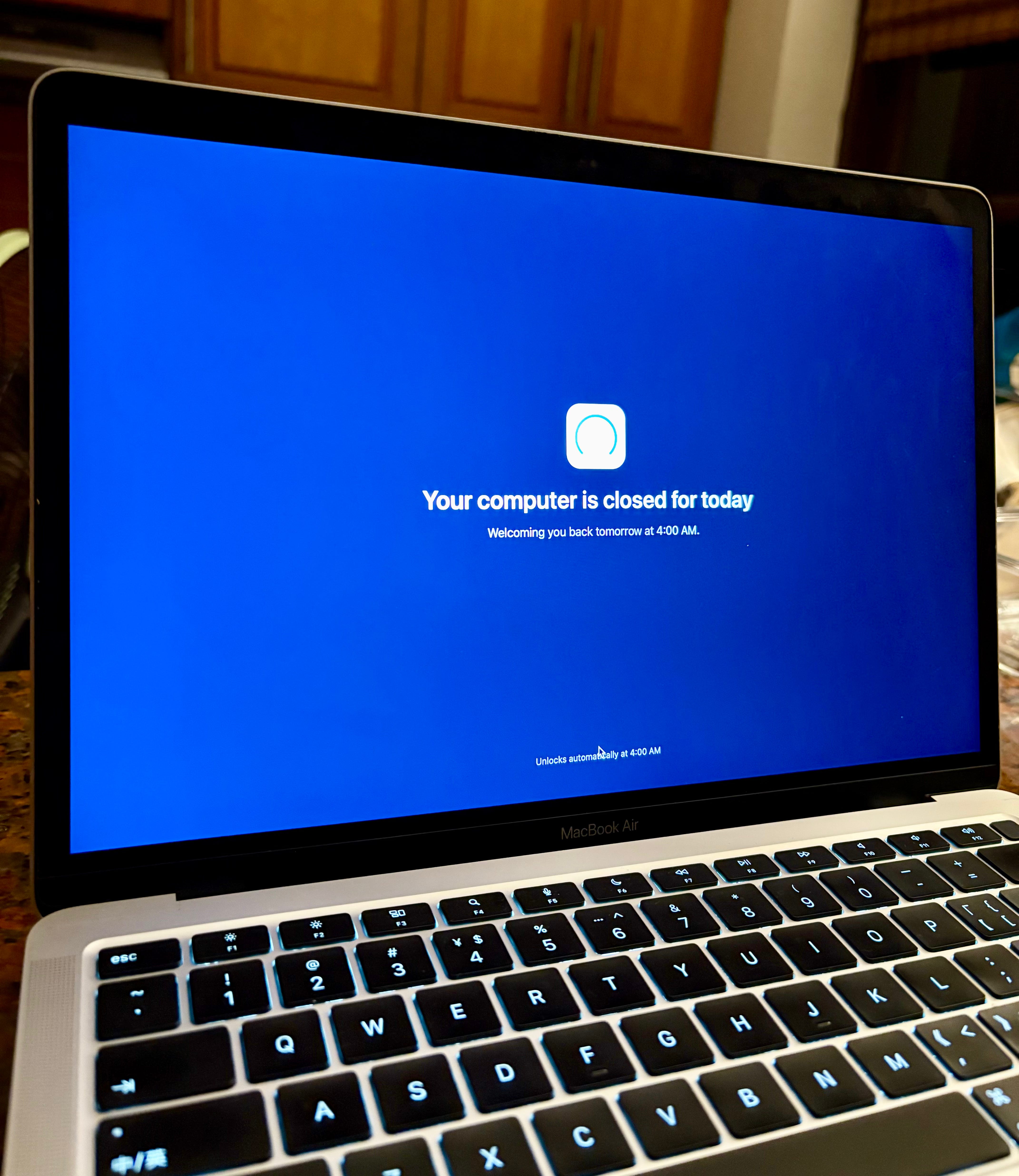
When it’s time to sign off, Lifeline locks down your system. The screen just says “Your computer is closed for today,” and you can’t use the machine again until the next morning.
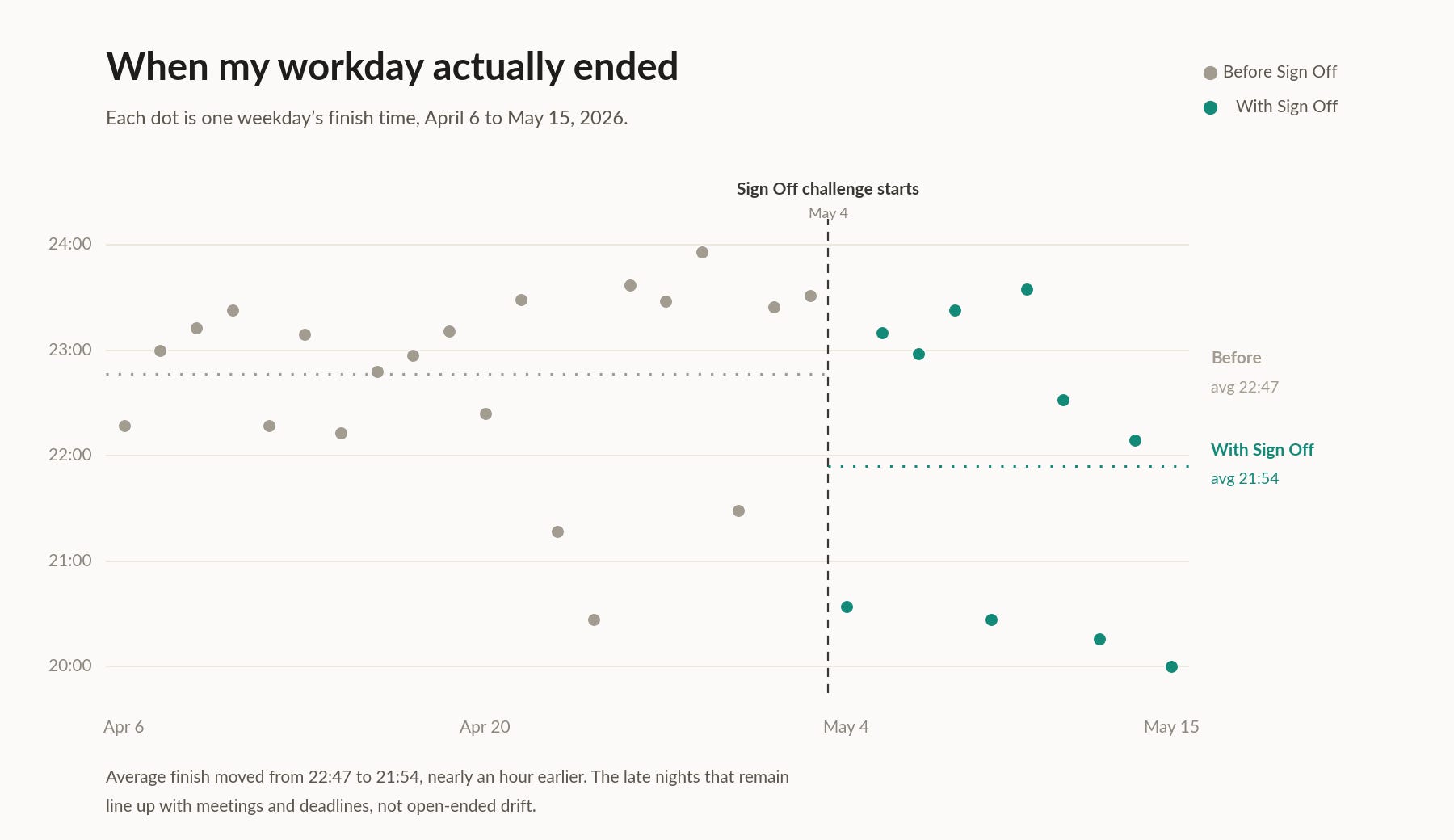
I've used this feature for the past two weeks, and it has really helped me finish earlier. Here's the chart I pulled from my Lifeline data (with Claude Code, through our new Lifeline MCP):
Try out the Sign Off feature in Lifeline 1.9 →
🛠️ Claude Code Office Hours
Next session: TODAY, Tuesday, May 19 at 10:30 AM ET.
Last week we mostly talked about Claude skills:
One person had a drawer full of overlapping skills, several near-duplicates, and wanted to consolidate them so Claude reliably picks the right one.
Another was starting from zero: where do skills even live on your machine, and how do they differ from commands?
A third had built a tool that scores content for AI-retrievability, then realized they had no way to measure whether the tool itself was working.
You can get recordings, summaries, and transcripts of previous sessions here:
https://customers.animalz.co/claude-code-office-hours
Stop by at our next session with any Claude Code stucks you have. Everyone is welcome.
Reads & Listens
Here’s what stood out in my reading and listening this week.
More reasons to doubt the man building our AI future
Reading Empire of AI last year is what first made me uneasy about Sam Altman. It sent me down a whole path: a piece on AI’s carbon footprint, an Anthropic-versus-OpenAI scorecard, and a small watchdog project I’ve been tinkering with.
This New Yorker investigation by Ronan Farrow and Andrew Marantz adds documented detail to the same picture. There’s material that featured in the book, but also spicy new stuff, like an internal memo about Altman that asserts he exhibits a consistent pattern of lying.
Sam Altman May Control Our Future. Can He Be Trusted? →
Every hour of the day has its own mood
A lot of my writing and thinking is, in one way or another, about time and how to spend it well. But it’s easy to think all time has to be optimized, or that it’s something we can always control.
Poet David Whyte captures this idea in a beautiful essay. I recommend you read it in full; here’s just one of the many passages that I loved:
To make friends with the hours is to come to know all the hidden correspondences inside our own bodies that match the richness and movement of life we see around us. The tragedy of constant scheduling in our work is its mechanical effect on the hours, and subsequently on our bodies, reducing the spectrum of our individual character and color to a gray sameness. Every hour left to itself has its mood and difference, a quality that should change us and re-create us according to its effect upon us.
Thanks for reading!
Tim
Because of my previous life as a productivity expert. (See saent.com/blog.)
Because it's so easy to kick off a task, and what else are you going to do while you're waiting?
The cruel twist: the people who multitask the most are the worst at it, and the most likely to overrate themselves. In one study, the more people multitasked, the lower their actual ability, and the more inflated their sense of it.
It turns out you really can fight fire with fire. When a wildfire is spreading, firefighters deliberately set a “backfire” ahead of it, burning up the fuel so the main blaze has nothing left to move into. It sounds too good to be a real technique. It is one. (Can you really fight fire with fire?)
At least, that's what we tell ourselves. The slot machine effect plays its part too: you never quite know what you'll find, and every so often there's something useful, so you keep checking. In Attention Span, researcher Gloria Mark found the average worker checks their inbox 74 times a day. One person in her study did it 374 times.
For a future release I'm thinking about adding an accountability buddy. You assign someone you can ping to lock you into your challenge.